

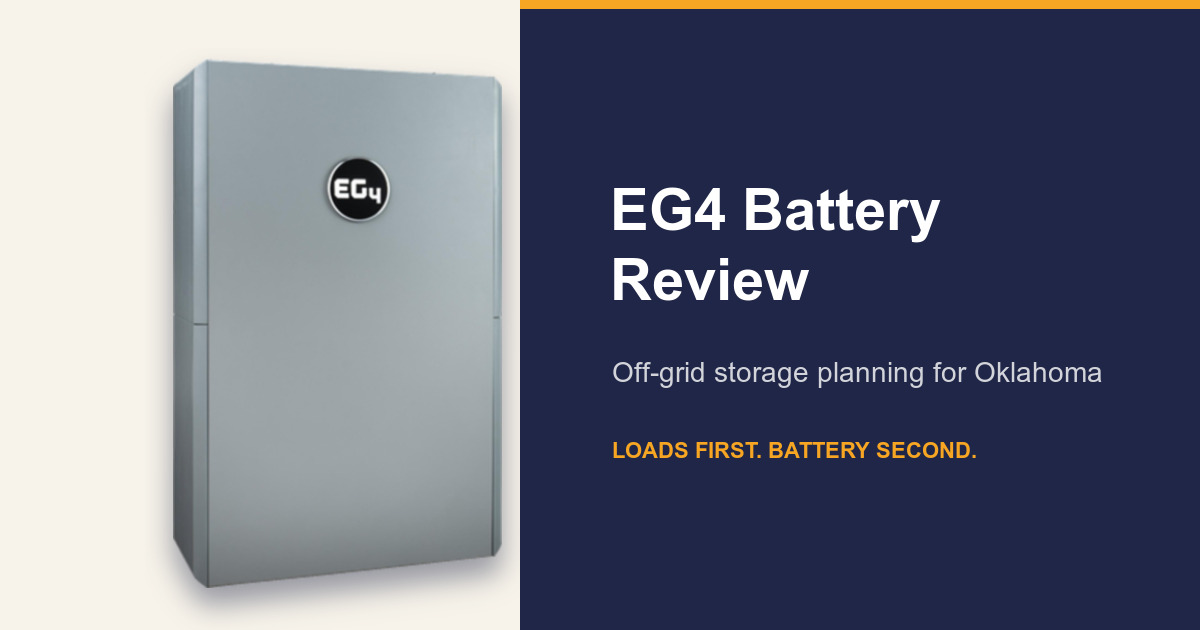
A serious Oklahoma off-grid battery conversation in 2026 starts with usable storage, surge loads, outdoor placement, and whether the system can recover after two cloudy days. EG4 is worth reviewing because it is not one battery. It is a 48V battery family that can be built around rack batteries, wall-mounted outdoor batteries, and EG4 hybrid or off-grid inverters.
That flexibility is the reason many Oklahoma homeowners ask about it. A Norman grid-tied backup system, a rural Cleveland County shop, and a true off-grid cabin do not need the same battery. They need the same question answered first: which loads have to keep running when OG&E, PSO, OEC, a co-op, or a long rural service run is not available?
How EG4 Batteries Actually Work
EG4’s current home battery lineup is built around lithium iron phosphate chemistry, usually shortened to LiFePO4. That chemistry is common in home storage because it is stable, long-cycle, and better suited to daily cycling than older lead-acid banks.
The simplest way to compare the EG4 options is by form factor.
- The EG4 WallMount 280Ah All Weather Battery is the outdoor-ready choice.
- The EG4 LL-S 48V 100Ah battery is the server-rack choice.
- The EG4 LifePower4 48V v2 is the lower-cost rack-style building block.
The EG4 WallMount All Weather page lists 51.2V, 280Ah, 14.3 kWh of storage, IP65 protection, UL 1973 certification, UL 9540A test documentation, integrated self-heating, a 10-year warranty, 8,000 deep-cycle design life, and 140A max continuous discharge. EG4 also lists compatibility with EG4 18kPV, 12kPV, 12000XP, and 6000XP inverters.
That makes the WallMount the cleaner starting point for many Oklahoma battery jobs. It is one large cabinet, it can live outside when the site plan calls for it, and it has self-heating for cold weather. The tradeoff is weight and placement. EG4 lists it at 308.6 pounds, so this is not casual garage shelving equipment.
The EG4 LL-S page lists a smaller 51.2V, 100Ah battery with 5.12 kWh of nominal capacity, UL 1973 certification, an onboard LCD, closed-loop communication support, E-Stop capability, dual fire arrestors, and up to 64 batteries in parallel while maintaining BMS communication. It is a better fit when the system belongs in a rack, utility room, shop wall, or dedicated battery space.
What This Means for Oklahoma Homeowners
Oklahoma changes the battery decision because the problem is not just backup. It is heat, storm season, winter outages, utility export value, and the gap between daily comfort loads and true emergency loads.
For a normal grid-tied home, EG4 usually makes the most sense when the owner wants more storage per dollar and is comfortable with a more designed system. Tesla Powerwall is simpler as a consumer product. FranklinWH has strong whole-home controls. EG4 is strongest when capacity, modularity, inverter choice, and off-grid expansion matter more than app polish.
For a rural property, the battery plan should start with loads:
- refrigerator and freezer
- internet, lights, and outlets
- well pump or pressure pump
- septic or aerobic controls
- gate, security, or shop loads
- mini-split or selected HVAC
- generator input for long cloudy stretches
A single 14.3 kWh WallMount can carry a tight critical-load panel for a short outage. It should not be sold as a magic whole-home battery. Central air, electric heat, a well pump, an oven, a dryer, and an EV charger can drain storage quickly or exceed inverter surge limits if the design is loose.
That is why off-grid EG4 designs often pair multiple batteries with load management and generator backup. Solar refills the battery. The battery runs the loads. The generator protects the system when winter weather, ice, or a long cloudy period beats the solar forecast.
What the Evidence Shows
A representative homeowner in rural Cleveland County might install a 12 kW system with two EG4 WallMount All Weather batteries, an EG4 12000XP inverter, and a critical-load panel. That array could produce roughly 15,000 to 17,000 kWh per year in central Oklahoma before shade, roof angle, temperature, downtime, and weather variation.
The battery side gives 28.6 kWh of nominal storage before design reserve, inverter losses, temperature effects, and battery management limits.
That is not an Affordable Solar customer case study. It is a planning scenario.
For this kind of home, the first pass might protect:
- a refrigerator and freezer
- internet and lighting
- one well pump circuit after surge verification
- garage door and selected outlets
- a mini-split or limited HVAC zone
- no electric range, dryer, or EV charging during outage mode
The technical challenge is usually not “will the battery store power?” It is whether the inverter, battery bank, conductor sizing, disconnects, grounding, rapid shutdown, transfer equipment, and load panel all agree with each other. NEC 690 covers solar circuits. NEC 705 covers interconnected power sources. NEC 706 covers energy storage systems. Inverters and ESS combinations also need the right UL 1741, UL 9540, UL 9540A, and UL 1973 context for the actual equipment package.
The WallMount is attractive here because one cabinet holds 14.3 kWh and is listed by EG4 for outdoor use at IP65. The LL-S is attractive when the site has a controlled indoor battery space and the owner wants rack-level modularity. The LifePower4 v2 is attractive when the budget needs smaller 5.12 kWh steps and the install location is appropriate.
The mistake is choosing the battery before measuring the loads. A 28.6 kWh bank can look large on paper and still feel small if it is asked to run central air through a hot August night. The same bank can feel generous if it runs refrigeration, lights, internet, a well pump, and one efficient comfort load.
What to Look For
If you are comparing EG4 for an Oklahoma home, ask what job the battery has to do. Before signing, verify the proposal against the actual loads instead of only the battery nameplate.
For short backup, ask which circuits are backed up and how long they should run. A tight critical-load panel is often better than pretending every breaker in the house is equally important.
For off-grid living, ask about winter recovery. A system that works in May can still be weak in January if the array is sized only around annual production. The design should show daily load, usable battery reserve, expected winter production, and generator strategy.
For outdoor placement, ask whether the specific battery model is rated for the location. The WallMount All Weather is the cleanest EG4 answer when exterior placement is part of the plan. Rack batteries need the right indoor environment, clearances, support, and service access.
For example, consider two homes with the same 28.6 kWh nominal battery bank. One home backs up refrigeration, lights, internet, a well pump, and a mini-split. The other tries to back up central air, an electric range, a dryer, and EV charging. The battery label is the same. The ownership experience is not.
For safety, ask for the equipment data sheets, installation manuals, one-line diagram, disconnect locations, battery spacing, and the exact inverter-battery pairing. Do not accept “EG4 compatible” as the whole answer. Compatibility should show up in wiring, communication, firmware, commissioning, and documentation.
For ownership, ask what the homeowner will see in the app or monitoring screen. EG4 can be very capable, but the ownership experience is more technical than a single-brand appliance-style system. That is fine if the design and handoff are clear.
EG4 can be a smart battery choice for Oklahoma. It is especially strong when the job needs scalable 48V storage, outdoor battery placement, or a larger off-grid budget than premium all-in-one batteries allow. It is weaker when the homeowner wants the simplest consumer app and the fewest design decisions.
The right EG4 system is not the largest bank you can buy. It is the battery bank that matches the loads, the inverter, the utility rules, the weather plan, the inspection path, and the owner’s tolerance for managing backup power.