

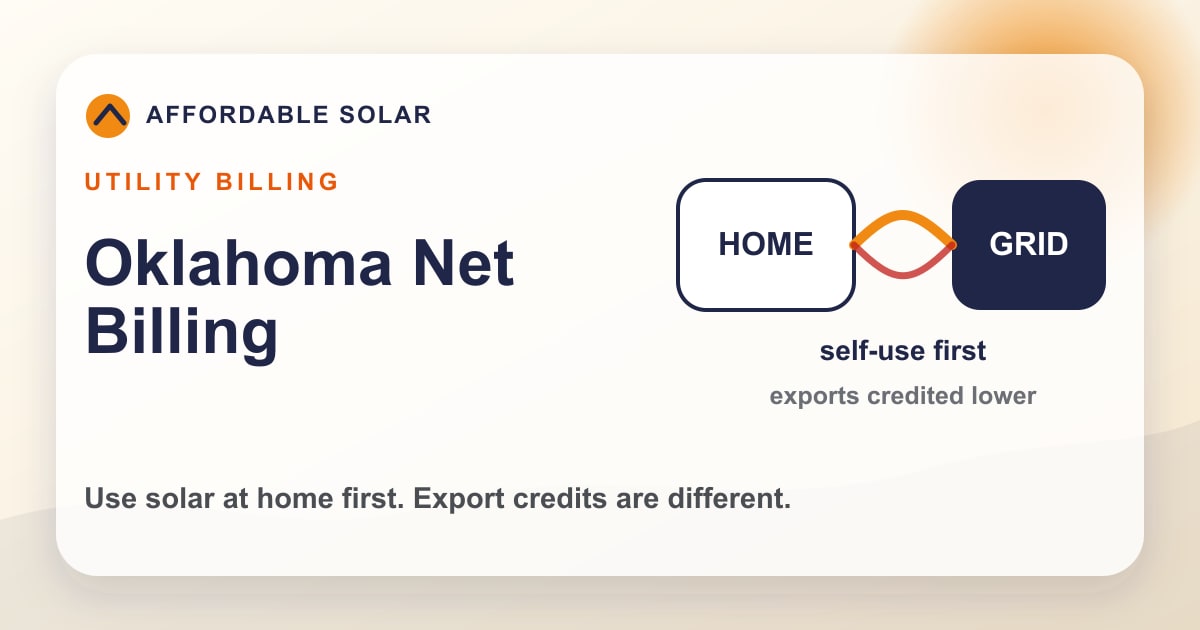
Oklahoma solar customers in 2026 are usually asking for net metering. What they actually need to understand is net billing.
That sounds like a small wording difference. It is not. In Oklahoma, the value of a solar kWh depends on whether you use it inside the house first or send it back to the utility. A kWh used in your home offsets the energy you would have bought from OG&E or PSO. A kWh exported after your home has already used what it needs is handled under the utility’s Net Energy Billing Option, usually called NEBO.
That difference changes system sizing, battery value, payback math and the questions you should ask before signing a solar proposal. It is one reason we spend so much time designing around real household usage instead of just filling the roof with panels. If you are comparing solar panel installation quotes in Oklahoma, this is the billing rule you need to understand before comparing the bottom-line savings number.
What Net Billing Means in Plain English
Net billing starts with a simple idea. Your solar production first serves your home. If your air conditioner, refrigerator, lights and appliances are using power while your panels are producing, that solar energy reduces what you buy from the grid.
That is the best use of a solar kWh. You avoid buying utility energy at the applicable retail rate, plus the fuel and rider pieces that apply to your bill.
Exports are different. When your system produces more than the house is using during the billing period, the excess energy goes to the utility. Under OG&E and PSO net energy billing rules, excess energy is credited in dollars using an avoided energy cost calculation. That credit is not the same thing as full retail value.
Here is the homeowner version:
- Solar you use immediately is worth the retail energy you avoided buying
- Solar you export is credited under the utility’s avoided-cost method
- The monthly customer charge and certain bill pieces do not disappear
- A bigger system is not automatically a better financial system
That last point is where many proposals get sloppy. A system can produce a strong annual kWh total and still send too much energy back at a lower export value. The design goal in Oklahoma is not maximum nameplate size. It is matching solar production, household usage and battery storage where it makes sense.
How OG&E Handles Net Energy Billing
OG&E’s current Net Energy Billing Option applies to eligible producers of 300 kW or less. For a normal home, that limit is not the issue. The practical design rule is the 125% peak-load cap. OG&E’s tariff says the generating capacity cannot be greater than 125% of the customer’s peak load, or the customer can be moved out of NEBO and into a different purchase tariff.
OG&E also requires the system to be located on the customer’s premise and intended to offset energy that would otherwise be supplied by the utility at that same location. You cannot combine usage from several properties to make one oversized home system look reasonable.
Monthly billing is the part homeowners care about. OG&E bills the customer under the applicable time-of-use rate schedule and says only the kWh portion of the standard bill is affected by NEBO. If the utility supplied more energy than the solar system provided during the billing period, the customer is billed for the net kWh supplied by OG&E. If the solar system produced more than the home consumed, the excess is credited or paid at OG&E’s avoided energy cost.
The avoided cost is tied to Southwest Power Pool day-ahead market prices. During the defined summer on-peak period, OG&E calculates separate on-peak and off-peak avoided energy cost values. Off-peak avoided cost is calculated for the other hours.
In plain English: OG&E is not buying your excess solar at the same value you avoid when your home uses that energy directly. That is why a Norman homeowner with high afternoon usage may see better economics than a house that exports most production while everyone is away.
How PSO Handles Solar Exports
PSO also offers a Net Energy Billing Option. PSO describes NEBO as a time-of-day based tariff. During the on-peak season, June through October, the time of use and the time of generation matter more because higher rates apply during weekday afternoon peak hours.
PSO’s customer-facing solar guidance explains that delivered energy and generated energy are netted, reducing the monthly bill by the kWh difference, including associated fuel charges. If the system produces more energy than was delivered during the on-peak and off-peak periods for the month, PSO pays for the excess energy using an average avoided energy cost.
PSO’s tariff has familiar limits. The facility must be 300 kW or less. It must be compatible with the line segment serving the home. It requires a standard purchase agreement and total kWh production metering. PSO also uses the 125% peak-demand rule, so a system that is too large for the customer’s load can be moved to a different purchase schedule.
The takeaway is not that PSO and OG&E are identical. They are not. Their service areas, tariffs, applications, meters and rate schedules differ. The practical design lesson is similar: exported kWh do not deserve the same assumption as self-used kWh.
That matters in Tulsa and eastern Oklahoma PSO territory just as much as it matters in Norman, Moore, Edmond and Oklahoma City OG&E territory.
Why Self-Use Matters More Than Roof Coverage
A solar proposal can look impressive when it shows a large system offsetting 100% of annual usage. But annual kWh offset is only one part of the picture.
The better question is when those kWh happen.
A south-facing array in central Oklahoma produces heavily during the middle of the day. A family may use a large share of its electricity later, when the sun is dropping and the air conditioner is still running. Under net billing, that timing gap matters.
There are three ways to improve the match:
- Size the system close to real usage instead of chasing maximum roof coverage
- Shift flexible loads, like laundry or EV charging, into solar production hours
- Add battery storage when evening usage or backup needs justify it
This is where solar battery storage becomes more than a backup conversation. A battery can hold midday production for the evening, when the home would otherwise buy from the grid. That does not mean every home needs a battery. It means the value of a battery depends on the home’s usage pattern, utility rate and the amount of solar that would otherwise export.
A good design starts with 12 months of utility usage. It looks at roof orientation, shade, household schedule, electric heat, pool pumps, EV charging and whether the homeowner expects new loads later. Then it sizes the system around how the home actually behaves.
What We See in Oklahoma Proposals
The most common mistake is treating exported energy like retail energy. A proposal may show a large annual production number, then apply a simple average utility rate to every kWh. That makes the savings look cleaner than the bill will feel.
Another mistake is hiding the customer charge. OG&E states that the residential customer charge is $13 per month. Solar does not erase that fixed monthly charge. PSO customers also keep an active utility account and still receive a bill. A post-solar bill can be much lower, but it should not be modeled as zero without explaining exactly what remains.
We also see confusion around the words net metering. Some older conversations use that phrase because it is familiar. Some utility pages still use it in customer-facing explanations. But the financial mechanics homeowners need to understand are net energy billing, avoided-cost credits and time-of-use behavior.
A representative example: a 9 kW roof-mounted system in the OKC metro can produce a strong annual total, but if the home is empty from 8 a.m. to 5 p.m. and has heavy evening air-conditioning load, a bigger array may increase exports more than self-use. A slightly smaller array, or the same array paired with a battery, can create a better bill result depending on the usage profile.
The electrical details matter too. Interconnection is not just paperwork. The design may need a supply-side tap under NEC 705, rapid shutdown compliance under NEC 690.12, a visible disconnect and meter work that matches the utility’s requirements. Billing and code design should be reviewed together, not after the sale.
Questions to Ask Before You Sign
Ask these questions before accepting any Oklahoma solar proposal:
- Which utility tariff did you use for the savings model?
- Does the proposal model net billing or assume one-for-one retail net metering?
- How much annual production is expected to be used in the home versus exported?
- What export credit assumption did you use?
- Does the system stay within the 125% peak-load or peak-demand limit?
- Does the design include the monthly customer charge that remains after solar?
- Would a battery improve self-use, or is it mostly for backup in this case?
- Which interconnection documents and utility meters are required?
If the salesperson cannot answer those questions, slow down. The problem may not be the panels. It may be the math.
The best proposals explain what happens in normal months, not just perfect months. They show why the system is sized the way it is. They separate self-used solar from exported solar. They explain what remains on the bill. They make the utility rules visible.
The Bottom Line for Oklahoma Homeowners
Net billing does not make solar a bad fit in Oklahoma. It makes design discipline more important.
A well-sized system can still reduce a large share of the bill, especially for homes with high daytime usage, rising summer air-conditioning load or a battery that captures midday production for evening use. A careless system can still produce plenty of kWh while leaving savings on the table because too much energy exports at avoided-cost value.
That is the real difference between a roof full of panels and a solar system designed around your bill.
If you are comparing quotes, do not start with the biggest array. Start with the utility rules. Then look at your usage. Then decide whether panels alone or panels plus storage make the most sense. In Oklahoma, the smartest solar design is the one that uses your own production before the grid gets it.