
Solar Installation
Solar Panel Installation Guide for Oklahoma Homes
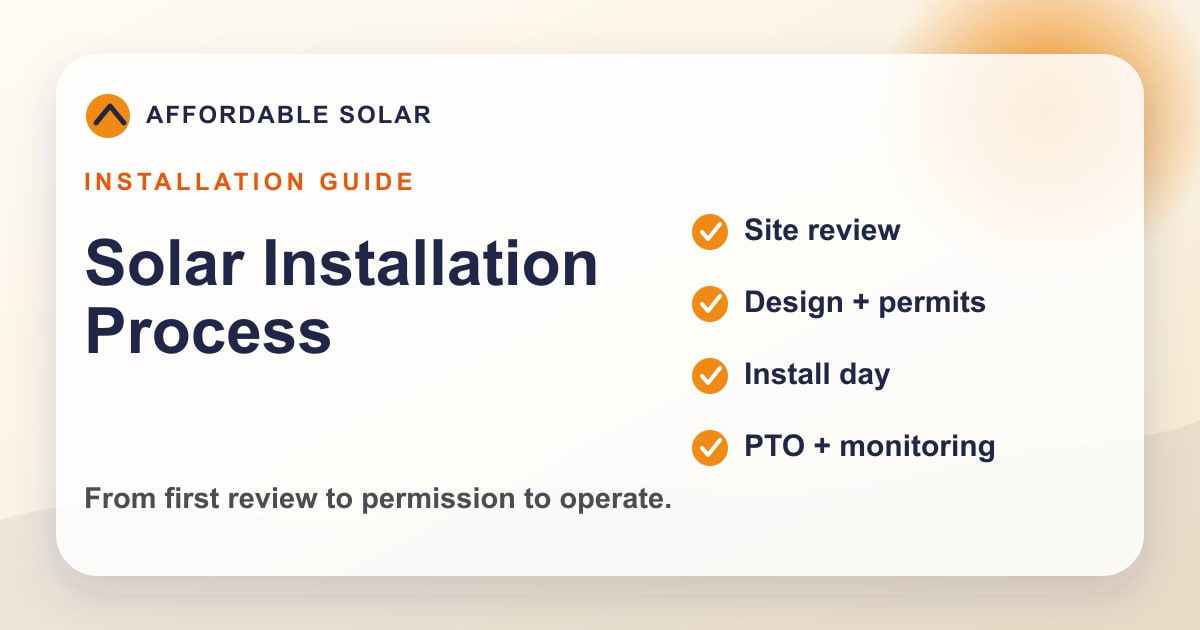
Step-by-step Oklahoma solar installation guide covering site review, design, permits, interconnection, installation day, inspection, and activation.

Quick answer
For most Oklahoma homeowners, the full solar panel installation process takes six to twelve weeks. The roof work is usually only one to three days; the longer timeline comes from design, permitting, HOA review, utility interconnection, inspection and permission to operate.
Step 1
Initial consultation, usage review and site assessment
Solar should not start with a panel count. It should start with the house, the utility bill and the reason you are considering solar in the first place.
We review your electric usage, roof age, roof shape, shade, main-panel capacity and long-term plans. A home that may add battery backup, a SPAN panel or a Level 2 EV charger needs a different electrical conversation than a simple grid-tied system.
What gets checked before design
- Roof condition: age, shingle condition, roof penetrations, reroof timing and whether detach-and-retach risk should be discussed first.
- Solar access: roof orientation, pitch, shade from trees or chimneys, and usable roof planes.
- Electrical capacity: main breaker size, bus rating, breaker space, grounding, service equipment and whether a panel upgrade is likely.
- Energy goals: lower bills, backup power, self-consumption, EV charging, new construction or off-grid planning.
If solar does not make sense for the roof or the numbers, the right answer is to say that early. A clean solar installation process is mostly about preventing surprises before anyone drills into the roof.
Step 2
System design, equipment selection and proposal review
The design turns the site assessment into a real scope. It should show where panels go, what the system is expected to produce, which inverter platform is being used, how wiring will route and whether the electrical scope supports future batteries or EV charging.
A strong proposal should not hide the practical details. You should be able to see the system size, estimated annual production, equipment assumptions, workmanship coverage, utility assumptions and any extra electrical work that affects the final cost.
Solar design choices
Panel wattage, inverter type, roof layout, production estimate, monitoring and storm/hail considerations for Oklahoma weather.
Electrical design choices
Main-panel capacity, interconnection method, battery readiness, EV-charger readiness, conduit routes and disconnect placement.
If you are comparing bids, pair this guide with our solar quote comparison checklist. The cheapest quote is not always the cheapest project if it leaves out panel upgrades, roof work, monitoring, permitting or utility assumptions.
Step 3
Permitting, HOA review and utility interconnection
This is the part of the solar installation process most homeowners never see, but it controls the timeline. Before installation, the project needs the right local permit package and utility interconnection paperwork.
Oklahoma projects can involve city permit review, electrical diagrams, equipment spec sheets, labeling plans, utility applications and HOA architectural review. OG&E, PSO and rural electric cooperatives each have their own interconnection flow, and the details matter because your system cannot be activated until the utility approves it.
Typical paperwork path
- Finalize the solar layout and electrical one-line.
- Submit permit documents to the city or authority having jurisdiction.
- Submit utility interconnection paperwork.
- Provide HOA drawings or equipment sheets where required.
- Schedule installation after approvals are ready or clearly sequenced.
For Oklahoma homeowners, this is also where net-billing expectations should be explained clearly. Your economics depend on self-consumption, your utility rate and how exports are credited. See our Oklahoma utility rate tracker for why this matters.
Step 4
Installation day: racking, panels, wiring and commissioning prep
Most residential solar panel installations take one to three working days once the project is approved and scheduled. Larger roofs, batteries, main-panel work, trenching, detached structures or complex conduit routes can add time.
Morning: layout, safety and roof attachments
The crew confirms the layout, stages materials, locates attachment points and installs the flashed mounting system that secures the array to the roof structure.
Midday: rails, panels and wire management
Racking rails are aligned, modules are clamped, wiring is managed under the array and rapid-shutdown equipment is installed as required.
Afternoon: inverter, conduit and electrical tie-in
The inverter or combiner equipment is mounted, conduit is routed, grounding and labeling are completed, and the system is prepared for inspection.
Your power may be turned off briefly while electrical connections are made. The system may look complete when the crew leaves, but it should not be treated as active until inspection and utility permission are complete.
If roofing work is part of the timeline, review the solar panel detach and reattach guide before scheduling the installation window.
Step 5
Inspection, permission to operate and monitoring setup
After installation, the authority having jurisdiction inspects the project. The inspector may review roof attachments, conductor protection, disconnects, labeling, grounding, equipment placement and the electrical tie-in.
Once local inspection is complete, the utility finishes its interconnection steps. Depending on the utility and meter setup, this may include a meter change, account update or written permission to operate. Only after that approval should the inverter be fully commissioned.
Full timeline summary
Activation should include monitoring setup, homeowner walkthrough and clear next steps for support. If production ever drops later, our solar panel maintenance and system-health checks can help find the cause.
Before you sign
Questions to ask every solar installer
- Will the proposal show the exact equipment and system size?
- Who handles city permits and utility interconnection?
- Is roof age or roof replacement a concern before solar?
- Does the electrical panel need work before installation?
- When can the system legally be turned on?
- How are OG&E, PSO or co-op exports valued?
- Can the design support batteries or EV charging later?
- What workmanship warranty covers the installation?
FAQs